

Soft water for a house that is younger than its plumbing looks
Spotted glass, a shower that never feels rinsed, a heater that already sounds tired. Hard water has been working on a new Adelanto house since the day the meter was turned on. A softener sized for your actual home stops the clock.
What the first decade of hard water costs you
Nothing about a new house in Adelanto looks wrong at first. The minerals are building up out of sight, inside the parts that heat water and the parts that shut it off.
Then it shows. Glass shower doors go cloudy and stay that way. Aerators clog. Fill valves and angle stops quit sealing years early. None of that is a defect in the house. The water here wears builder-grade fixtures out on a schedule, and softening it ends that cycle.
Sizing for your house, not the brochure
The number printed on a softener box is there to impress. The one that matters is your water’s hardness times what your household actually uses.
Test what is in the line
Hardness gets measured at your tap. That reading sets the grain capacity the resin has to keep up with.
Count the real demand
Four people and three bathrooms need a different machine than two people and one. Irrigation and a big tub change it again.
Match the flow rate
Undersize the valve and the shower drops off when the dishwasher runs. The unit has to pass the flow the house calls for.
Set regeneration honestly
A metered head regenerates on the water you actually use, which means less salt, less rinse water and longer resin life.
Where the unit ties in, loop or no loop
Some builders leave a softener loop in the garage: two stubs, capped or joined by a short jumper, near where the water enters the house. With one, the tie-in is short. Without one, we cut into the incoming line at the right point. Either way the soft water feeds the fixtures and the heater, and at least one hose bib stays untreated, because nobody wants to soften the landscaping.
The drain and the brine line
Regeneration sends rinse water somewhere, and that discharge needs an approved drain with an air gap so nothing back-siphons into your supply. It is the most improvised part of this job, and the part we never improvise.

Salt-based or salt-free, said plainly
A salt-based softener pulls the hardness out and trades it for a little sodium. It needs salt and a drain.
A salt-free conditioner skips both and does something narrower: the minerals stay in the water and cling less to pipes and heaters. It earns its place protecting equipment. If you wanted soft skin and clear glass it will disappoint you, and you hear that before the install.
Describe the symptom and we will name the machine that answers it, then give you a firm price before we start.
When filtration belongs in the plan too
Sediment and taste take their own equipment, and the water test tells us whether you need any. Finished installs are in our gallery.
Softener questions we get from new Adelanto homeowners
How do I know whether my garage already has a softener loop?
Look along the garage wall near where the water comes in for two stubs close together, capped or joined by a short jumper, sometimes behind a small access panel. If they are there, send us a photo. If not, that is common, and it only changes where the tie-in happens.
Will a softener make my water taste salty?
No. The salt stays in the brine tank to rinse the resin. What reaches the tap carries a little sodium in place of the hardness minerals, and if that matters to you medically, we talk about a potassium fill or a separate drinking water tap.
Is a salt-free conditioner as good as a real softener?
It is a different tool. A conditioner makes the minerals less likely to stick inside pipes and heaters, but the hardness stays in the water. A softener removes it, which is what you feel in the shower and see on the glass.
Can the softener live outside?
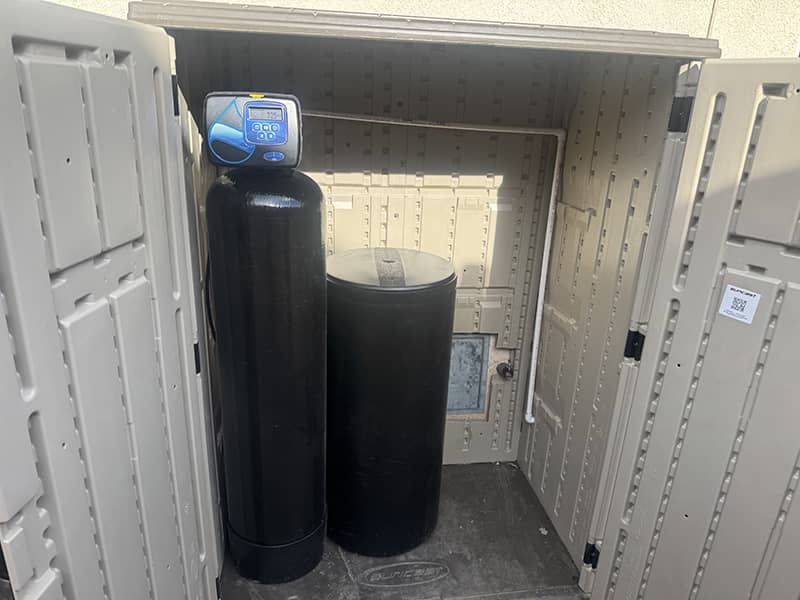
It can, in a proper cabinet that keeps sun off the tanks and sand out of the valve, and plenty of High Desert homes run theirs that way. Left unprotected, the plastic and the control head age fast.
Do I need filtration along with the softener?
Sometimes. Hardness, sediment and taste are separate problems with separate answers, and we test first so we can tell you plainly whether a softener alone covers it. Selling you a second tank you do not need is not how we work.
Find out what your water is really carrying
We test the hardness at your tap, look at where a unit would go, and give you a firm price for the right size. Financing is available on bigger water treatment work.
Where service and integrity create a legacy
A.O. Smith certified on water heaters and Handle certified, working out of Victorville since 2019. Locally owned, correct the first time, serving the High Desert and Inland Empire, and open 24 hours Monday through Saturday.
Open 24 hours, Mon to Sat
Victorville, CA 92395